Find the coordinates of a point on a circle.
Calculating the coordinates of a point on a circle typically depends on the information you already know (such as the angle, the position of the circle’s center, etc.). The most commonly used method involves trigonometric functions.
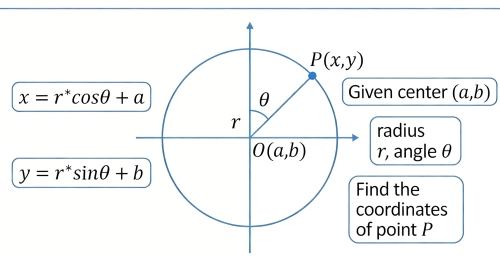
Standard Circle (Centered at the Origin)
If the center of the circle is located at the origin $(0, 0)$ of the coordinate system, the radius is $r$, and the angle between the point and the positive direction of the $x$-axis is $\theta$, then the coordinates $(x, y)$ of that point are:
$$x = r \cdot \cos(\theta)$$$$y = r \cdot \sin(\theta)$$
A Circle in a General Position (Center Not at the Origin)
If the coordinates of the circle’s center are $(x_c, y_c)$, the radius is $r$, and the angle is $\theta$, then the coordinate calculation formulas must be translated:
$$x = x_c + r \cdot \cos(\theta)$$$$y = y_c + r \cdot \sin(\theta)$$
Important Considerations and Tips
Radian Conversion:
In most programming languages (such as C#, C++, and Python), the trigonometric functions cos and sin use radians rather than degrees.
- Conversion Formula: $\text{Radians} = \text{Degrees} \cdot \frac{\pi}{180}$
Coordinate System Orientation:
- In a standard mathematical coordinate system, the positive direction of the $y$-axis points upward, and angles increase in a counter-clockwise direction.
- In computer graphics or screen coordinate systems, the positive direction of the $y$-axis typically points downward. If you find that the rotation direction is reversed, you can try modifying the calculation for $y$ to: $y = y_c - r \cdot \sin(\theta)$.
- Circular Motion / Equidistant Points: If you need to calculate $n$ equidistant points on a circle, the angle for the $i$-th point is given by: $$\theta_i = \frac{360^\circ}{n} \cdot i$$
Code Reference (C#/Unity)
 1// Example: Calculate the point at an angle of 45 degrees.
 2float angleDegrees = 45f;
 3float radius = 5f;
 4Vector2 center = new Vector2(10, 10);
 5
 6float angleRadians = angleDegrees * Mathf.Deg2Rad;
 7float x = center.x + radius * Mathf.Cos(angleRadians);
 8float y = center.y + radius * Mathf.Sin(angleRadians);
 9
10Vector2 pointOnCircle = new Vector2(x, y);